Sunday, 14 October 2012


Why does Barfi score over Chaplin?

Barfi is replete with Chaplinesque moments. No, I don’t mean Charlie Chaplin. Although there is a fair share of that in Ranbir’s antics and the deliberately old world background score. I am talking about Anindo Banerjee’s Bengali movie Chaplin (2011), featuring Rudranil Ghosh in the title role. Depicting protagonists who laugh in the face of adversities, both movies uphold the spirit of Charlie Chaplin. While Barfi does it through a love triangle, sans bitterness, Chaplin achieves the comedian’s essence through a father-son relationship. Scripted by Padyanabha Dasgupta, a year before Anurag Basu, Chaplin shares many merits and flaws with Barfi. However the thriller angle in Barfi gives it an edge over Anindo Banerjee’s film


Artists at heart, Barfi (Barfi), Bangshi and Nimua (Chaplin), imaginatively fill up voids in their lives. The deaf and dumb Barfi proposes to Sruti by seemingly placing his beating heart on a tea plate. Bangshi and Nimua dip dry pieces of bread in water, pretending to enjoy a sumptuous meat curry. Two lonely, upper-class women, Sruti (in Barfi) and Rina (in Chaplin), discover simple joys in life through their interactions with the protagonists. Slapstick humour in both movies disguises pangs of poverty, making us smile through tears.

Superlative performances by the lead actors constitute another highlight of these movies. Effortless gliding from slapstick comedy to poignancy establish Rudranil Ghosh and child artist Soham Maitra as acting geniuses. Relying only on expressions and gestures in Barfi, Ranbir Kapoor and Priyanka Chopra render physically and mentally challenged individuals touchingly real. Ileana D'Cruz is marvellous as a woman caught between the promise of a stable but insipid upper- class existence and the excitements of   Barfi's trampish life.
    
On the flip side, both films suffer from melodramatic moments. Barfi conveniently runs into Sruti in an over-crowded city like Calcutta. Romance is stretched to the extreme when Sruti abandons her comfortable married life for Barfi's hovel or when Jhilmil and Barfi practically die in each other's arms. Chaplin too ends on a needlessly dramatic note. Determined to fulfil the wish of his terminally ill son, Bangshi organizes Nimua’s birthday party instead of performing in the final round of a comedy contest. But as Bangshi entertains Nimua with his Chaplinesque antics in a darkened theatre; Rina dramatically walks in with press reporters and the entire crew of the comedy contest. The film ends with artist Bangshi finally getting his overdue appreciation.
   
Despite these similarities, Anurag Basu counteracts sugary-sweet romance with  Jhilmil's actual and fake kidnappings. Although the second half drags a little, Jhilmil and Barfi's escapades revive the pace. The plot gets convoluted. But Basu cleverly makes one of the characters retell Jhilmil's three escapes/kidnappings, clarifying it for the audience. Lacking any such angle, the pathos in Chaplin hangs heavy after a while. Comic attempts by some side characters appear forced. Rachita's inconsistent acting mars some genuinely touching scenes.
   
However, as we celebrate Barfi's official entry to the Oscars, let's not forget our regional cinema. Made a year before Barfi, Chaplin gives quite a competition to this Bollywood blockbuster. 

Sunday, 2 September 2012

                                      Blurring Bounds               
I sit outside Chicago’s famous Art Institute. Exhausted after a hectic city tour, my mind teems with images of ancient and contemporary art and architecture. This city has turned the most mundane of objects into architectural splendours. A massive circular edifice houses a set of residential and commercial apartments and is fittingly called the Corn Cob. Whimsical steal webs conceal state-of-the-art sound systems, forming a sprawling outdoor auditorium at the heart of Millennium Park. 
Inside the Art Institute intricate neoclassical sculptures, opulent furniture and fantastically designed paper weights encapsulate centuries of human achievement. One is delighted, and awestruck by the marvels around. As I sit musing, the wealth of experience gathered over the last two days weighs down on me. And the "windy city" ironically feels devoid of air. 

Suddenly my reverie is punctured. “Would you like a paper, miss? Just a quarter”. I look up to find a dark man - a weary grin pasted on a sweaty face - his tired muscles almost refusing to stretch into a smile. “No, thank you!” I blurt out instinctively. The smile melts away – he drags his weary legs down the steps and accosts another man. This time he tries a little joke. The man laughs, shakes his hand but buys no paper. I see the lines on the dark man’s face deepen until they seem sculpted into his countenance – as fixed as the ones on the statues I gazed at the Art Institute. I wait in anticipation; fearful, that those lips will not peel back next time to reveal a set of white teeth – the forced signs of politeness will desert the man for the day. 

As his tired, intermittent grins gradually settle into a grimace, a lump begins to form in my throat. My eyes blur and the images become indistinct. I hear the dull roar of traffic punctuated by shrill honking. A shrivelled palm is thrust in front of me and a snot-covered child looks up whining for alms. “Sorry! No change!”, I exclaim and walk on. Her litany follows me down the familiar arcade on Park Street until it is drowned in the usual Kolkata bustle. 

A cold breeze stings my face and I can taste the brine at the corner of my mouth. I find myself back on the wide, clean steps of Chicago Art Institute. My eyes scan past the hobbling figure on the sidewalk to settle on a huge, middle-aged woman seated on the ledge of a shop-window. The empty McDonald’s cup looks absurdly small in her enormous hands. She could almost be a comic character out of a Disney animation movie until she thrusts the cup out at a passerby, asking “Got any change?” Some people dole out a few coins; some a pitying smile, while others do not even spare her a glance. Strangely enough, the triangular recycling sign hovers before my eyes. I hear distant voices – “Recycle plastic cups, recycle glass bottles – save the environment”. The chant has become all too familiar ever since I came to the US. But this woman gives a new import to recycling. I wonder if the environment-friendly people thought of this option.
City landmarks along Chicago river (top)
Skyscrapers by Lake Michigan (bottom)

The Chicago skyscrapers glisten against a blue summer sky. Huge flowerpots line the sidewalks while plush cars whizz by. It is a far cry from the busy, potholed streets of Kolkata with its snail-paced traffic. But I am not dazzled anymore. Chicago has lost the “glory and freshness of a dream”. Yet it has left something else in its wake – a strange intimacy. I am not a tourist anymore. I know the hobbling newspaperman, I know the beggar-woman, I know the callous passerby. I know the HUMAN FACE. The "windy city" has indeed lived up to its name, sweeping boundaries away. I suck in the cold air – long and deep. 
And . . .  FEEL . . . FREE!

Monday, 6 August 2012


Clearing the Victorian Fog: Doyle's Holmes vs Sherlock 

While I am in the Sherlock mode, let me jabber a little more about the series. I was just reading John Watson’s blog. Yes, the blog of John H. Watson actually exists and is replete with spin-offs from the original stories. My favourite is The Speckled Blonde! You guessed it right – it’s a cheeky twist on The Speckled Band. In 2012, the evil stepfather is not an ex-colonial officer but a cosmetics tycoon. The snake is a red herring, owned by the dead woman’s fiancé and the fatal weapon is a bubble bath. 

This nugget of a case encapsulates Sherlock's fascinating twists on the original stories. The sci-fi thriller version of The Hound of the Baskervilles is the best. Doyle's novel portrayed a world teetering dangerously between superstition and science. Steven Moffat and Mark Gatiss (the writers of Sherlock) launch us into the terrifying milieu of chemical and biological weapons. The hound is no longer a fiendish beast covered in phosphorous but a nightmarish image created by the victims' own horrified psyche. Instead of a vengeful aristocrat we have a sinister scientist suffusing the 'moor' with noxious fumes that generate paralyzing nightmares. Exploiting contemporary paranoia about biological terrorism, the writers clear off the Victorian fog, distilling the essence of Doyle's novel. 

And they do the same for the super sleuth. Holmes is stripped off all the Victorian trappings except for his scintillating deductive powers. Sherlock fans will of course delight in the brilliant update of famous deduction scenes.Instead of a watch, Holmes spews Watson's life-history from an i phone with an impish touch at the end. Holmes is spot on about everything regarding Harry Watson - his drinking, his divorce, his tenuous relationship with John. He just misses one small detail - Harry is short for Hariette - Harry is Watson's sister and not his brother!

The creators do an equally brilliant job with the new stories. The Great Game gets my vote. An unknown criminal mastermind compels Sherlock to solve 'little puzzles' within strict time limits. If Sherlock fails, a random hostage will blow up. The fascinating aspect of this episode is to see Sherlock being kept on razor's edge by a sadistic adversary. The books provide an implicit assurance of Holmes's infallibility. But as the detective's analytic prowess is strained to its ultimate limit in The Great Game, the audience worries about his potential failure. Particularly tense is the scene where Sherlock declares a painting to be fake, but the villain refuses to release the hostage until Sherlock proves why it is fake. As the clock ticks on the screen, the audience waits in feverish anticipation, wondering if the detective can actually score over his antagonist. 

The anticipation is justified when we know that the antagonist is none other than James Moriarty - "the Napoleon of crime" as Doyle's detective had labelled him. Sir Arthur never fleshed out the schemes of Holmes's "intellectual equal". The series fills up this void with elan. In The Great Game, Moriarty makes Holmes dance to his tune by exploiting the detective's obsession with crime solving. The Reichenbach Fall depicts his diabolical intelligence as Moriarty nearly convinces everyone that Holmes is a fake.
Serial Killer; A Study in Pink (top); 
James Moriarty The Reichenbach Fall (bottom)


Unfortunately, Andrew Scott's performance shatters the menacing charm built up by the plot. His deliberately guttural voice and melodramatic dialogue delivery reduces Moriarty into a clownish, comic-book villain. In fact Phil Davis, who played the serial killer in A Study in Pink, would have made the perfect Moriarty. His calm but chilling ruthlessness, his arrogance, his razor-sharp mind, constitute the perfect ingredients for Holmes's arch enemy. 

Much like Moriarty's performance, the climax of The Reichenbach Fall is a downer. The fact that Moriarty bribes the staff instead of using a computer key code to unlock the Pentonville prison, the Bank of England and the Crown Jewels; undermines the power of this evil genius. Similarly, the plot of A Scandal in Belgravia is riddled with holes. It's utterly unconvincing that Sherlock would fail to detect that the dead woman with a disfigured face is not Irene Adler - especially since she had bared it all; walking in on Sherlock stark naked with red lipstick and red heels. In her dominatrix avatar, Holmes's THE WOMAN appears cheesy rather than seductively smart.

I hope that the writers fix these faux pas in the next series, for, episodes like A Study in Pink, The Hounds of Baskerville and The Great Game establish their smartness.  Meanwhile I will satisfy my Holmes mania with Sherlock's and John's blog. And of course with the good old memoirs of Dr. John H.Watson!  

P.S. Fellow Holmesians can access John's blog  here: <http://www.johnwatsonblog.co.uk/>
      
  And for a real humbling experience browse through 
"The Science of Deduction": <http://www.thescienceofdeduction.co.uk/>

Thursday, 2 August 2012


‘Cumberbitten’ but not ‘Sherlocked’
The ‘Cumber’ flu has taken over half the world now. Look no further than the Olympic opening ceremony and you will hear Benedict Cumberbatch’s deep voice declare: “Let the games commence”!  Commemorating the actor’s birthday on the 19th of July a leading daily devoted an entire page analysing why so many girls have been ‘cumberbitten’. The BBC series Sherlock of course formed the highlight of the piece. As an i-phone toting, tech savvy, twenty-first century Holmes in a chic overcoat and scarf, Cumberbatch has supposedly transformed this ice-cold detective into the ‘sexiest’ thing on television. Frankly, I was rather amused to hear this.

Cumberbatch as Holmes (left); Sidney's Paget's illustration in the original stories (right)
I find Cumberbatch’s Sherlock quite melodramatic but definitely not sexy. His striking good looks are rather distracting – not quite Holmesian. In my mind’s eye, Holmes’s tall, thin form with piercing eyes and hawk-like nose, never quite spells ‘handsome’. And then there is Benedict’s breathless dialogue delivery. The actor and the writers tell you that it captures the lightening speed of Holmes’s deduction and his brilliant but utterly impatient mind.

However, the stories always paint a different picture of the detective for me. Yes, Holmes is edgy and debilitatingly rude at times. He cuts off Watson’s florid description of a lichen-covered wall with “cut the poetry, Watson. I note that it was a high wall”. But when it comes to retracing his deductive trail for mere mortals like Watson or Lestrade, he does it with a slow, deliberate relish. The series could have retained that aspect.  After all, the director brilliantly portrays Holmes’s supersonic deductive speed through the texts that flare up on screen, while Sherlock’s single glance culls a person’s minutest details.

Cumberbatch’s Sherlockian mannerisms too are over-the-top. Holmes has a touch of the dramatic. In the book he gleefully springs up from his chair after inventing a chemical test for detecting old bloodstains.And Watson tells us that he “bowed as if to some appalauding crowd conjured by his imagination”. But this twenty first-century Sherlock carries such eccentric flashes to the extreme. A Sherlock, who jumps up and down on the couch or sniffs up a client’s smoke rings, because Watson has confiscated his cigarettes; looks clownish; not delightfully eccentric.

I don’t want to carp. The series has many merits and not least of them is the Sherlock-Watson relationship. Martin Freeman is not the overawed, subservient sidekick of the black and white Sherlock Holmes movies. This new-age army doctor is more of an equal player with an assertive persona and a cheeky sense of humour. My  favourite is the scene where Holmes asks a puzzled Watson to punch him in the face.
Holmes snaps:  “PUNCH ME-IN THE FACE - didn’t you hear me?"
Watson retorts: “I always hear ‘PUNCH ME IN THE FACE’ when you speak. But that's USUALLY  SUBTEXT” 

The creatives transcribe Holmes and Watson's underlying affection with commendable subtlety. Particularly memorable is the scene where Holmes rushes to tear apart the explosives Moriarty had strapped on Watson. The  detective, who had proclaimed to Moriarty that he does not have a heart, morphs into a heartwarming friend the moment Moriarty leaves. As Sherlock awkwardly acknowledges John's bravery, one is reminded of  the scene in Doyle's The Three Garridebs when Watson is shot by a criminal and Holmes exclaims: "You're not hurt, Watson? For God's sake, say that you are not hurt!" Moved by this rare display of emotion, Watson remarks: "It was worth a wound - it was worth many wounds - to know the depth of loyalty and love that lay behind that cold mask"  
And it is this "depth of loyalty and love" that is revealed in the  final phone conversation between Holmes and Watson in the series. As Holmes prepares for his fatal leap in the last episode of Sherlock Season 2, Cumberbatch’s quavering voice and slight facial twitch, expose a carefully repressed human side of this consulting detective.Ironically, much like Holmes's sentimental side, Cumberbatch's acting prowess finds only a fleeting display in Sherlock. 

During his decade long career prior to Sherlock, Cumberbatch essayed characters that showcased his talent way better than this BBC series. In the series The Last Enemy he played Stephen Ezard - an obsessive, socially awkward, mathematician who is sucked into a political maelstrom. Shorn of exaggerated gestures, forming the  hallmark of "Sherlock", Benedict made Ezard's bewilderment and vulnerability terrifyingly palpable.And in Hawking, Benedict portrayed the scientist’s grit and agony with heartrending realism. Ironically, the performance that has made him a household name, lacks these very qualities.  

Finally, much has been made of the actor’s baritone. His deep, sexy voice hooks ‘cumberbitches’ even to  fifteen-minute-long car commercials. I plead guilty to the ‘sin’ as well. His incredible voice modulation can transport you to the World War I battlefield or to the verudous realm of Keats’s Nightingale, with equal ease. But his off-screen persona is no less impressive. His smartness and erudition stand out when he talks about his roles. Just listen to him speaking about the shattering of chivalric ideal during World War I, in one of his interviews on War Horse, and you would know what I mean. And of course one can’t help adoring someone who can respond to abuses like ‘horse-faced and arse-named’ with “that’s what I have been born and blessed with”. So at the risk of crafting the cheesiest sign-off, I admit that I am ‘cumberbitten’ but not quite ‘Sherlocked’! 

Tuesday, 3 July 2012

Laptop: a memorable montage; not quite a memorable movie

A few hesitant piano notes sound in the background, a cello groans into life and some random images flash across the screen. A despondent man rides in an open truck, surrounded by his belongings, a car cuts through lush tea gardens, a blind man taps his way through city streets, a child peeks at a stranger from his father’s embrace, a pensive boy lies alone on a train berth. 
And a few cryptic words appear discreetly on the montage – “shift”, “windows”, “vision”, “memory”. 
As the promo closes with the title Laptop, familiar keypad terms resonate with new meaning. 
Be it in terms of performances, dialogues, cinematography, editing or music, subtlety defines most parts of Kaushik Ganguly's latest movie venture.

A line, a word or a gesture, amply etches nuances of characters and relationships, as men and women from various social and psychological backgrounds momentarily intermingle. A lower-middle class father’s (Pijush Ganguly) joy after buying a secondhand laptop for his 
computer-student son, finds expression in a rather lavish purchase of mutton. A rude, overbearing tea planter (Saswata Chatterjee) exposes his softer side in a single line about his surrogate child: 

“ছুটে এসে যখন বাবা  বলে  জড়িয়ে  ধরে  . . . তখন  মনে  হয়  . . . আমার  ছেলে ”. 

A blind author (Kaushik Ganguly)   offers a unique “vision” of reality, claiming that his “characters” save him from loneliness. His subsequent rendition of “এই  লভিনু  সঙ্গ  তব  সুন্দর  হে  সুন্দর ”, enriches both the song and the scene.

Brilliantly understated performances from veterans (Saswata Chatterjee, Arindam Sil, Rajesh Sharma, Rahul Bose) and youngsters perfectly complement this nuanced screenplay. Special mention must be made of Pijush Ganguly’s breakdown, following accusations of stealing, and Aparajita Adhya’s quavering voice as she desperately asserts her husband’s dignity against Arindam Sil’s scathing charges. Kaushik and Ananya move effortlessly from tenderness to sentimental sulking to downright bitterness, capturing various shades of an undefined relationship between author and typist. Churni's artificial manner of speaking highlights her strain in maintaining the decorous veneer of a posh tea planter's wife. Gaurav balances the naïveté and street-smartness of Jion with perfect élan. His half-truths bring a smile while his helpless gasps following the exposé are heartrending.

Sirsa Roy’s cinematography and Mainak Bhaumik’s seamless editing create some lasting cinematic moments. A mundane close-up of milk blending in tea, suddenly morphs into a womb-image with an incessant heartbeat in the background. The author’s (Kaushik Ganguly) wonder about pervasive human fear of death, despite the everyday demise of our dreams and relationships, cuts to a long shot of Rajesh Sharma, a funeral truck driver. With Kaushik’s philosophical musings in the background, the camera slowly pans on Sharma, sleeping peacefully in the vehicle.  
Yet such crisp editing becomes a bane elsewhere in the movie, leaving several unanswered questions. We see Jion fiddling with the newfound laptop and staring at Raya’s (Ridhima Ghosh) photos in it. But we never know what exact information he derives from the machine and how. Consequently his discovery and pursuit of Raya remain completely unconvincing.

Glaring holes in the plot and unnecessarily dramatic twists further mar a potentially brilliant film. How does a poor driver (Rajesh Sharma) steal the laptop from a swanky medical clinic and that too from the director’s office?  Why does the clinic’s laptop contain information about the director’s daughter? The hurried pace of  the Jion-Raya track leave nagging queries in its wake. Arindam Sil orders Jion’s family to leave the city within a day and they conveniently move to their ancestral home in Malda. Such melodramatic twists destroy the otherwise realistic tenor of the film. In a bid to focus on the surrogacy angle, the writer rushes through the first half, ignoring significant details about the laptop’s initial journey. Thus despite many laudable elements Laptop remains a montage of a few moving moments but fails to be a memorable movie.


Wednesday, 20 June 2012


Moraine State Park

“Want to visit a state park tomorrow?” asked my housemate over the phone
“Sure!” said I, “where is it? What’s it called?”
“It’s called Moraine State Park - an hour’s drive from Pittsburgh”

Once my housemate got home we started scouring the internet for information. Moraine State Park lay 50 miles north of Pittsburgh in a small town called Portersville. The park’s website promised all kinds of exiciting adventures, from biking to fishing, hiking, boating and kayaking. Apparently a camper's delight, the park also offered a range  of cabins at various prices. “Rustic” cabins for 2 to 3 persons could be rented for as low as $200 per week . It seemed perfect!


Sharp at ten the next morning we were on our way to Portersville. A warm, inviting October sun caressed our faces as we drove out of Pittsburgh. It was high Fall and the wooded hills on either side blazed with orange, pink, yellow and red foliage. After about an hour’s drive the signs declared that we were in Moraine State Park. Our car winded its way through partly wooded roads until it reached a large open area, marked as car park. Jumping out of the vehicle we readied our cameras. Click. Click. Click – went our little devices, taking in the wide grassy meadows with a few straggling picnic tables, the bright blue sky and trees dressed in their best Fall colours! 

But before long we realized that the area was utterly empty. A cool breeze kept up a low, steady roar in our ears as we walked around. An invisible bird tweeted now and then. But it was funny how desolation renderd such a picturesque landscape rather eerie.  Spying a small cement hut at a distance we decided to check it out. It seemed like an office building with brochures and maps of the area arranged in a stand outside. Unfortunately, the door was closed. We tried the handle only to get an obstinate crunch in return. “Well, so much for our boating and biking plans!” sighed  my friend.

According to the map we were in the Pleasant Valley area of the park. A carved wooden sign on the left read “Sunken Garden trail”: one of the numerous hiking trails crisscrossing the park. Perhaps we could hike later in the day. But for now it was time for some quiet afternoon lunch by a murky pond. After a while a long, narrow kayak came lazily cutting through the pond. An old couple paddled away in perfect sync.

“That looks so cool!!” squealed one of our friends
 “Didn’t the website say that we could rent boats? Should we go check?” ventured the second.
The brochure indicated that we must head to McDanel’s boat launch, north-west of Pleasant Valley.

But as we strolled uphill, en route to the boat launch a breathtaking view opened up on our right. Two massive islands jutted out on to a sparkling blue lake. This was Lake Arthur – the giant water body at the very heart of the park. A yacht went gliding past, its massive white sail with yellow and navy patches billowing out against the wind.  Our luck indeed changed from this point on. 

McDanel’s boat launch was teeming with people. Cars drew up hauling in little boats behind them or with long kayaks strapped to the roof. At the launching area men were busy untangling thick ropes as they got ready to zoom away in their motor boats. Tired from all the walking we entered a small shop, fittingly called OWLET, for some refreshments. The woman at the shop informed us that a cruise was about to leave the dock in half an hour. Just $10 would provide a grand tour of the Lake. 

So off we went on a big white vessel marked NAUTICAL NATURE! The inside of "Nautical Nature" looked like a large rectangular room with wide square windows. An aisle divided two rows of seats. Brownish orange plastic maple leaves twined the four walls, close to the ceiling, keeping up the Fall feel. Except for the stack of life jackets in a corner, a bearded man behind the stearing wheel and a soft gurgle of water now and then it was hard to tell that we were inside a boat.


“Welcome aboard, people!” hollered a vivacious old lady. 
Her deep wrinkles scarcely undermined the sprightliness of her smiling grey eyes.  Even the usual cautionary statements and instructions lost their tediousness as they emanated from her affable voice.

“As you all know, we are in Moraine State Park”, began our guide. “But can anyone tell me why it’s called Moraine?”
“Because of glacial activity”, I blurted, my high school geography popping up in my head.
“Yes! Excellent! This entire area originates in glacial deposits”

And with that she launched into a history of the park. About 140,000 years back a continental glacier dammed up some local area creeks to create three major lakes. Towards the north Slippery Rock Creek created Lake Edmund, towards the southeast sprouted up a tiny Lake Prouty and in the middle the Muddy Creek created Lake Watts. Eventually Lake Prouty carved out the Slippery Rock Creek Gorge, now lying towards the west of Moraine State Park, forming part of McConnell’s Mill State Park.

But Lake Arthur was a man's handiwork - Dr. Frank W. Preston's, to be precise. An amateur English naturalist, Preston came to the area in 1926 to set up a glass research lab. But his naturalist side soon detected the signs of glacial sculpting. Unfortunately, the landscape had been much abused by mining activities and oil drills.  Rich limestone, clay and coal deposits catered to a booming mineral industry. But Preston set about restoring the natural beauty, setting up the Western Pennsylvania Conservancy in the process. With friendly assistance from Pennsylvania departments of Forests and Waters and Mines and Mineral industries, Muddy Creek was dammed and Lake Arthur emerged as a smaller version of the original Lake Watts. Soil was fertilized and thousands of trees replaced mines and oil wells. Moraine State Park was up and ready by 1970 with the 30foot deep Lake Arthur in its centre.

As our cruise sailed along the lake vibrant pink, orange and yellow woods melted into one another upon the surface of the water. Ripples broke on the multi-coloured shadows, leaving thin white foams. The beauty was mesmerising! Tall poles with small clumps at the top jutted out of the water in places. “Bird’s nests” – pointed out our guide. These poles were deliberately built to provide nesting grounds for birds. And to offer tourists a chance to watch exotic creatures like the osprey, blue heron and bald eagle. The park’s brochure mentions that ospreys or “fish hawks” were reintroduced in the area in 1993. But of course, in keeping with the law of every state park none of these creatures honoured us with a glimpse! Their absence wasn’t a downer, however, as passengers took turns to step out onto a small deck in front of the cruise. As the vessel ploughed through the water, the sun shone in our faces and the wind roared in our ears.

On our way back from Moraine State Park our car stopped to make way for some horse riders. “That’s for next time!” was our pledge as we headed home.

Unfortunately the equestrian adventure eluded us on our second trip to Moraine this summer. When my friend called a number listed on the brochure to enquire about horse riding, the lady on the other end didn’t know what he was talking about. She seemingly had no idea that horses could be ridden!!!
“Perhaps those people we saw last time brought their horses with them along with boats and kayaks!”, we joked.

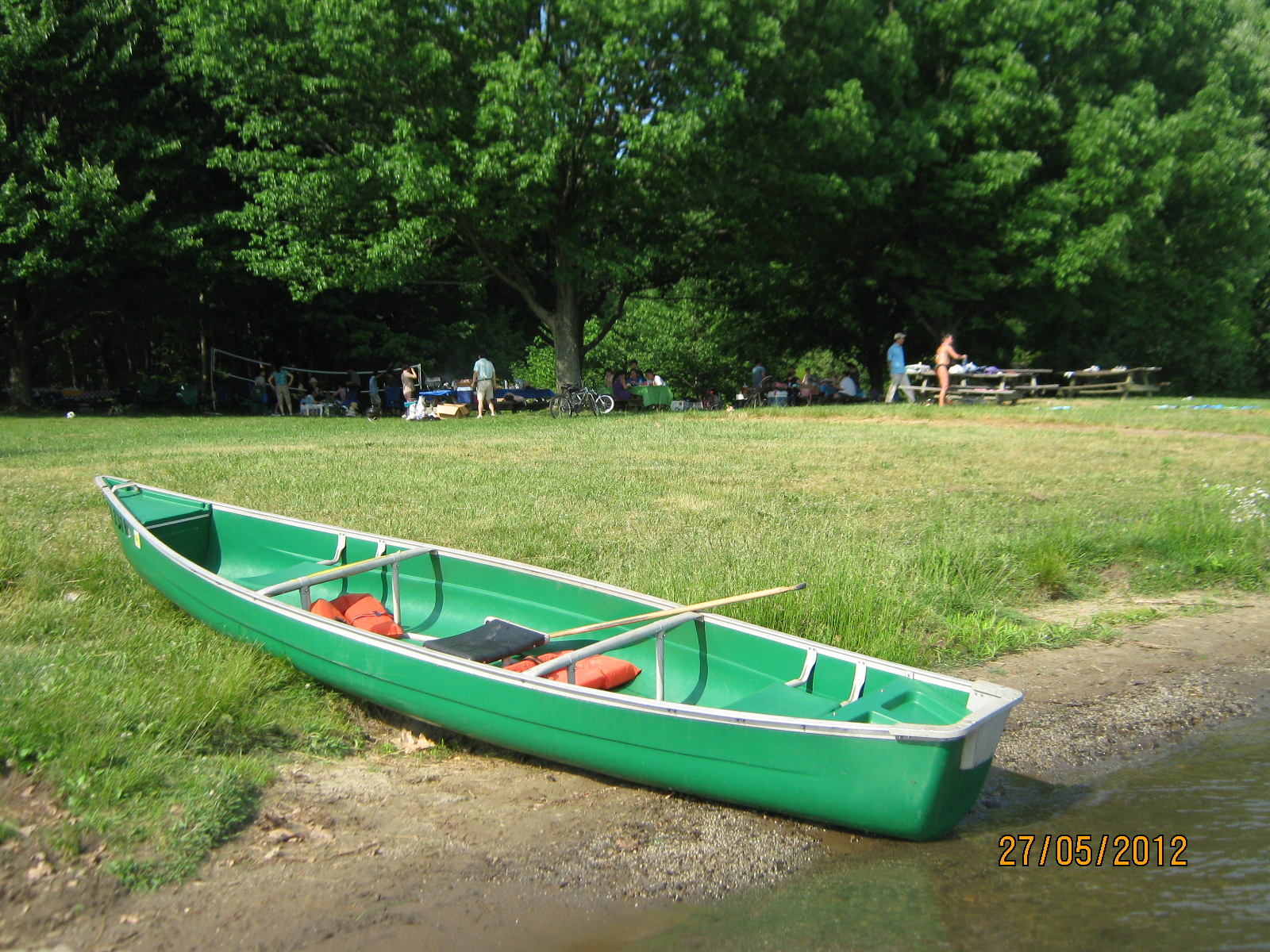
Speaking of kayaks brings me to the highlight of our second trip. Yes, we did kayak on Lake Arthur, for one whole hour and for $14 per kayak. It was my first time on one of these strange crafts. I thought my legs would be crushed as I looked at the seat inside an oval hollow cut out in the front. Surprisingly, however, there was enough space not only for my legs but also for my rather large hand bag. My partner settled into the hollow behind me, for we had rented a double kayak, and with our oars in hand we were ready to set off! Of course my initial kayaking would have put a toddler’s steps to shame! Lacking all sense of direction and thrilled about my first kayaking experience, my oars hit the water in all different angles. So instead of going forward our kayak promptly hit the launching board! One of the lifeguards pushed the craft back into the water with a grin, but it wasn’t long before I nearly collided with another kayak heading for the shore. Eventually my partner had to provide an impromptu kayaking lesson!

“O.K. Listen! When you want to go right, paddle left! When you want to go left, paddle right! And when you want to go straight, paddle on both sides! Got it?”

But of course in my excitement I kept making mistakes. Finally my partner took to yelling “Left, left, left – right, right right – now keep straight”! It felt like being back in my high school Physical Training class!  


Eventually I got the hang of it and we went deeper into the lake, sailing against a wind that got chillier and stronger! Our other friend sailed up next to our kayak and started taking pictures. Far out in the distance long wooded shores of the lake bobbed up and down. An island jutted a little way out on the left. We decided to race each other as we kayaked towards the island. But it was much farther away than it seemed. Only halfway towards the island a glance at the watch told us that it was time to return.  Panting and giggling like school children, we got out of the kayaks and headed to Lakeview beach, southeast of McDanel’s boat launch. 

Unlike a desolate sandy stretch in the Fall, Lakeview Beach now was a cheery haunt. Colourful umbrellas dotted the area. The air rang with barking dogs and squealing kids as they splashed in the water with adults. Settling down under a broad shady tree we quietly smiled at each other. 

True, we didn’t enjoy all the recreations promised on the website.  
And yes, on our first trip we seemed to have entered a ghost town!  

But neither the website nor the brochures had promised the breathtaking shadows of Fall foliage melting into Lake Arthur or the exhilaration of paddling a kayak against the wind. 

A journey that began with a whimsical phone call  did indeed reveal a slice of paradise in a quiet corner of Pennsylvania.